

Are AI Prompts Worth Buying in 2026? An Honest Guide

Table of Contents
- Are AI Prompts Worth Buying? The Honest Answer
- Are AI Prompts Worth Buying? The Honest Answer
- How to Customize AI Prompts for Faster Content
- The Real Risks: Security, Privacy, and License Traps
- Selling AI Prompt Packs on Gumroad: What Changes When You Switch Sides
- Do You Need the Best AI Prompt Engineering Courses to Get Value?
- Prompt Maintenance: The Cost Nobody Talks About
- Are AI Prompts Worth Buying for Your Situation? A Decision Framework
- Frequently Asked Questions
Last Updated: September 27, 2026
Are AI Prompts Worth Buying? The Honest Answer
The short answer: sometimes. AI prompts are worth buying when they save more time than they cost and include rights you can actually use. This guide from DP Crate breaks down when to pay, when to walk away, and how to spot the difference.
Are AI Prompts Worth Buying? The Honest Answer
Buying AI prompts is worth it when the pack solves a specific, repeated task and includes clear resale or commercial rights. It is not worth it when you buy volume instead of fit.
What You Are Actually Paying For
You are paying for four things, and only one is the prompt text.
- Structure: A defined role, context, task, and output format already assembled for you
- Variables: Editable fields you fill in instead of rewriting the whole instruction
- Guardrails: Constraints that stop the AI from inventing facts or claims
- Rights: A license that tells you whether you can rebrand or resell the pack
When Free Prompts Are Enough
Free prompts are enough for one-off tasks, when you are still learning what good output looks like, or when you only need the AI to brainstorm. Free stops being enough at repetition. If you run the same task weekly, with the same structure, for the same audience, a tested prompt pays for itself fast. One-off tasks: free. Recurring tasks: worth paying for.
How to Customize AI Prompts for Faster Content
Customizing AI prompts for faster content means replacing generic fields with your own context before you hit send. The prompt is the skeleton; your details are the muscle.
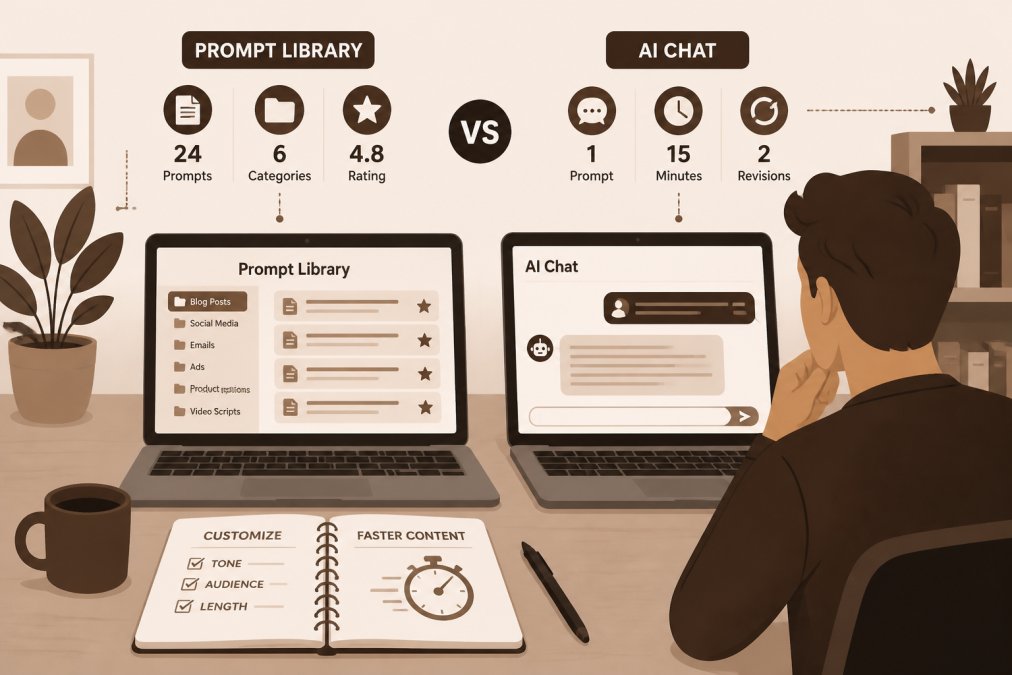
Here is the workflow that consistently saves time:
- Copy the prompt into a plain-text document
- Highlight every bracketed variable
- Replace each one with your real audience, offer, and tone
- Delete any instruction that does not apply to your task
- Run it once, then note what came back wrong
- Add one constraint that fixes that specific failure
- Save the revised version as your own template
The Variables That Do the Heavy Lifting
Four variables change output quality more than anything else: audience, goal, tone, and format. Get them right and most prompts perform well; get them wrong and no clever wording will save the result.
The Real Risks: Security, Privacy, and License Traps
That produces three practical exposures:
- Confidentiality. Proprietary strategy, unreleased pricing, or client identities pasted into a prompt can end up outside your organization's boundary.
- Regulatory. If the data includes personal information, health details, or financial records, you may be creating obligations under privacy and sector rules that your use of a third-party prompt did nothing to satisfy.
- Contractual. Many client agreements and vendor contracts restrict where their data can be processed. A prompt pack does not know about those clauses.
A workable rule set:

- Substitute, don't paste. Replace real names, account numbers, and figures with placeholders, run the prompt, then swap the real values back in yourself.
- Strip before you send. Remove anything that identifies a person, a client, or a deal.
- Match the tier to the data. Keep sensitive work on a business or API account whose terms you have actually read, not a personal chat window.
- Check the provider's current settings. Data-retention and training controls are configurable on most major platforms and are not always on by default.
- Ask before you assume. If a prompt's value depends on feeding it live internal data, get sign-off from whoever owns that data first.
License traps are the second hazard. "PLR" and "MRR" do not mean the same thing across sellers, and they rarely mean "do whatever you want." Some packs allow rebranding, some allow resale of finished copies only, some allow neither. The letters are a seller's shorthand, not a standardized legal category, only the written terms attached to the pack matter.
Check three things before you buy:
- Does the license explicitly permit commercial use?
- Does it permit modification and rebranding?
- Does it permit resale, and if so, of the finished product or the source files?
How to Verify Quality Before You Pay
- Look for one full sample prompt. Not a screenshot of a table of contents, and not a three-word teaser. You want to see the whole instruction, start to finish.
- Check whether variables are bracketed and editable. If the fields are not clearly marked, it is a copy-paste script, not a system you can adapt.
- Search the listing for guardrails. Phrases like "do not fabricate" or "human review required" signal a seller who has actually run these prompts and hit the failure modes.
- Confirm the license in writing. Ask for the terms document if it is not published. A seller who cannot produce it cannot grant you rights.
- Check the update date. Prompt packs go stale as models change. A pack with no revision history is a snapshot, not a maintained product.
- Look for a refund policy. A clear, stated refund window is a signal the seller expects the product to hold up.
- Sanity-check the seller's footprint. A real business has a support address, a terms page, and a history. A single sales page with no contact path is a warning sign.
This is the same diligence you would apply to any digital product. Prompt packs are cheap enough that buyers skip it, and that is exactly when the privacy and license traps catch people.
Selling AI Prompt Packs on Gumroad: What Changes When You Switch Sides
Selling AI prompt packs on Gumroad flips the economics: you set the price, and the value question becomes whether buyers can see what they are getting.
The AI Prompt Pack Blueprint: Build →

- A narrow niche. "Marketing prompts" is too broad. "Customer support prompts for e-commerce teams" tells a buyer they are in the right place.
- Visible structure. Show the actual prompt format, including variables and output sections.
- Honest scope. Say how many prompts are genuinely distinct, not how many rows are in the file.
Do You Need the Best AI Prompt Engineering Courses to Get Value?
No. You do not need a course to get value from purchased prompts. But the useful question is not "course or pack", it is whether your problem is a missing prompt or a missing skill. Those need different fixes, and buying the wrong one wastes money.
- If the output was close but not quite right, and you can name what is missing, you have a skill gap you can close with practice. You probably do not need a course, and you may not need a pack either.
- If the output was close but not quite right, and you cannot name what is missing, that is the case where structured instruction earns its price. You are missing vocabulary for the variables that control output.
- If the output was unusable and you do not know where to start, a tested prompt pack gets you to a working result faster than a course will, because it hands you the structure already assembled.
- If the output was good and you just want it repeatable, you need a template, not instruction. Save your own prompt and move on.
Prompt Maintenance: The Cost Nobody Talks About
Prompt maintenance is the ongoing work of updating prompts as models change, outputs drift, and your offers shift, the cost almost no listing mentions.
Budget for it. A realistic rhythm:
| Maintenance Task | Frequency | Time Needed |
|---|---|---|
| Re-run your top 5 prompts | Monthly | 30 minutes |
| Fix formatting drift | As needed | 10-15 minutes |
| Update audience and offer variables | Quarterly | 20 minutes |
| Review license terms on resold packs | Before each launch | 10 minutes |
| Retire prompts that no longer fit | Quarterly | 15 minutes |
Are AI Prompts Worth Buying for Your Situation? A Decision Framework
Use this framework to decide in under two minutes.
Buy if:
- You run the same task at least weekly
- The pack includes editable variables and clear output structure
- The license explicitly covers your intended use
- You can see at least one full sample prompt
Skip if:
- Your task is a one-off
- The pack is a flat list with no variables
- The license is vague or missing
- You only need the AI to brainstorm
Build your own if:
- You already have a working prompt you reuse
- Your niche is narrow enough that generic packs miss it
- You want to sell the result later
For teams that need volume fast, a large organized library is the practical starting point. The 100,000+ ChatGPT Prompt Bundle covers business, marketing, writing, social media, productivity, and coding prompts with PLR and MRR rights where the applicable license provides them. The 11,500+ AI Prompt Bundle for ChatGPT, Claude, and Gemini is organized by task type so you can find a starting point without scrolling.

Frequently Asked Questions
How much does an AI prompt pack actually cost?
Most one-time prompt packs sell between $9 and $30. DP Crate's own bundles sit in that band: the AI Productivity Blueprint is $9.00, the 11,500+ prompt bundle is $17.97, the 100,000+ ChatGPT prompt vault is $17.99, and the role-specific packs like the U.S. Customer Support or Sales Development workflows are $27.00 each. All are one-time purchases with no subscription, so the only recurring cost is your AI tool itself. Compare that price against the hours you would spend writing prompts from scratch before deciding whether AI prompts are worth buying for your workflow.
Can you make money selling AI prompts?
Yes, but the money comes from packaging and licensing, not from the prompts alone. Sellers who do well pick a specific niche, organize prompts into a branded product, and offer clear usage rights. A resell-rights pack lets you rebrand the product, rename it, add your own logo, and keep 100% of your retail sales, which is how freelancers and Shopify owners turn a $27.00 file into a product line. The AI Prompt Pack Blueprint covers this process, including how to structure personal-use and resell-rights tiers so one core product supports several price points.
Do pre-made prompt packs save time for business owners?
They save time when the pack matches work you already repeat. A support team that rewrites ticket replies daily gets faster results from a pack built around ticket triage, escalation handoffs, and review responses than from generic prompts. The savings come from skipping the blank page, not from skipping review. Every prompt still needs your context, your approved claims, and a human check before anything goes out. If a pack covers tasks you do once a quarter, the time saved is small and the purchase is harder to justify.
Are prompt engineering courses worth the money?
Courses help if you plan to build or sell prompt products and need structure around niches, branding, pricing, and licensing. They help less if you only want faster output on a few recurring tasks, where a well-built prompt pack plus practice gets you there. Before paying for a course, check whether it covers prompt structure, testing, model-specific differences, and resale rights. A $9.00 practical guide like the AI Productivity Blueprint covers prompting fundamentals and a 30-day practice challenge, which is often enough to judge whether you need deeper training.
The hard part is not deciding whether to buy prompts. It is finding a library organized well enough that you actually use it. DP Crate builds ready-made digital resources, including AI prompt bundles and rebrandable prompt packs, with PLR and MRR rights where the applicable license provides them, plus automatic savings at checkout when you add more products to your crate. Explore the Crate and start with prompts you can put to work today.